Architecture
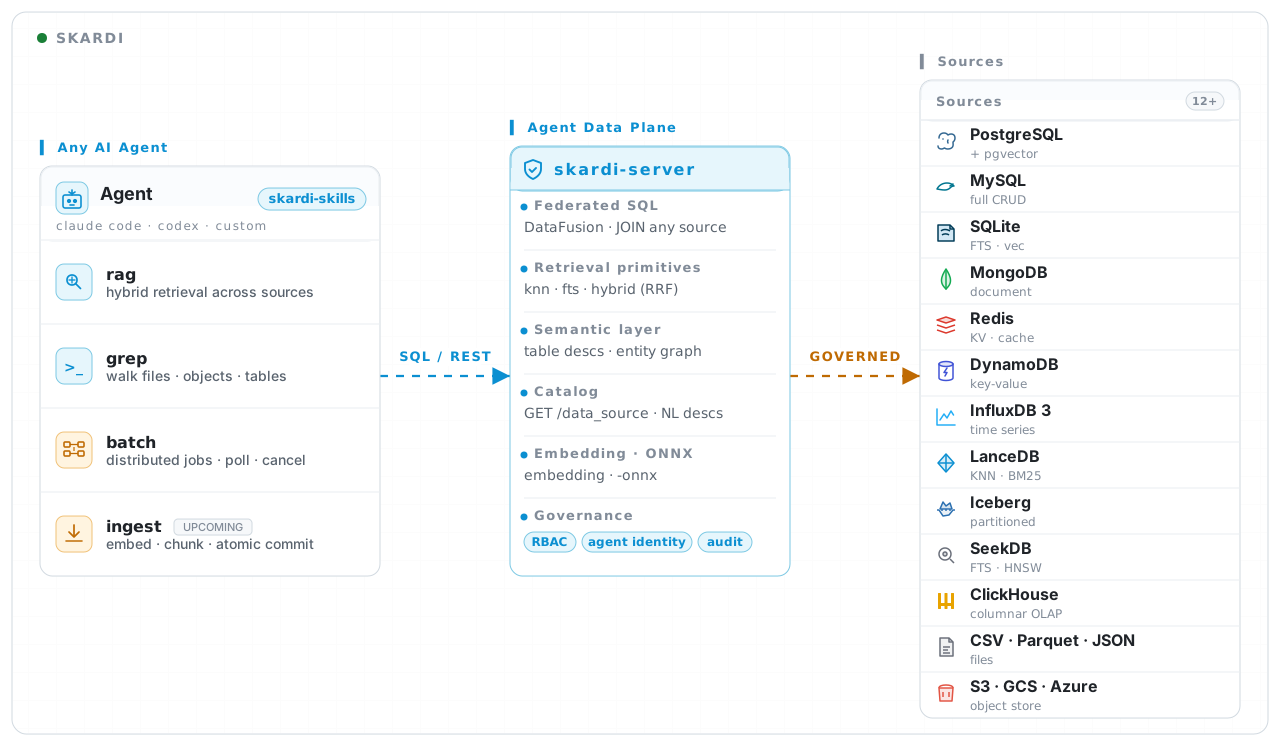
One Rust process (DataFusion in-process) plus a small SQLite file for the ledger and optional auth. One server serves many agents; deploy it next to your data, behind your usual auth.
- Federated SQL — one statement across every registered source, no application-side joins. docs/federated-queries.md
- Pipelines — a YAML file with parameterized SQL becomes a REST endpoint
(schema inferred) and a
skardi runverb. This is what the loop promotes into. docs/pipelines.md - Semantic overlay — plain-English descriptions of tables and columns served
on
GET /data_source, so the agent reads what data means before querying instead of guessing from a schema dump. docs/semantics.md - Offline jobs — async batch writes with atomic commit, crash recovery and a run ledger you can list and inspect. docs/jobs.md
- Retrieval built in — KNN, FTS and hybrid RRF in SQL;
candle()embeddings,chunk(),onnx_predict()andllm_extract()as UDFs, so content and vector land on the same row atomically. docs/embeddings/
Most sources read a store that already holds rows. RSS/Atom is the one that reaches out over the open web at query time — one DataFusion partition per feed so a dead feed degrades alone, and, because feed URLs are agent-authored input, a fetch deliberately left un-sandboxed in OSS for operators to gate at the infrastructure layer. See docs/rss.md.